The eleven lines between the eyebrows tell stories most people would rather not broadcast. They flare when you squint into sun, tighten when you focus, crease when you worry. If you are asking how many Botox units you need for frown lines, you are really asking two things: how strong is your corrugator-procerus complex, and how smooth do you want the result. Let’s unpack the dosing, placement, and the trade-offs that determine whether your glabella looks refreshed or frozen.
What “glabella dosing” actually means
Frown lines form from a small team of muscles that pull the brow inward and down. The corrugators draw the inner brows together, making vertical creases. The procerus pulls the central brow down, contributing to the horizontal crease at the bridge of the nose. Botox weakens these muscles by blocking acetylcholine at the neuromuscular junction. Dosing is measured in units, which are specific to each brand formulation. Most clinical studies for frown lines reference onabotulinumtoxinA (Botox Cosmetic). Equivalence across brands is not 1 to 1, so 20 units of Botox is not the same as 20 units of Dysport or Xeomin. Stick to brand-specific dosing guidance.
When injectors talk about glabella dosing, they also mean the pattern of injection points. The typical pattern uses five points: one in the procerus and two in each corrugator, with careful attention to depth and angle so product lands in the belly of the muscle and not more superficial tissues.
The reference range most people start from
For an average adult, 15 to 25 units of onabotulinumtoxinA in the glabella is the evidence-based range. The FDA pivotal trials used 20 units split over five points for reliable softening that lasts three to four months for most patients. I see light responders do well at 12 to 16 units, especially if lines are early and the brows are not heavy. Strong muscular foreheads and those who furrow during concentrated work often need 20 to 25 units to fully quiet the movement.
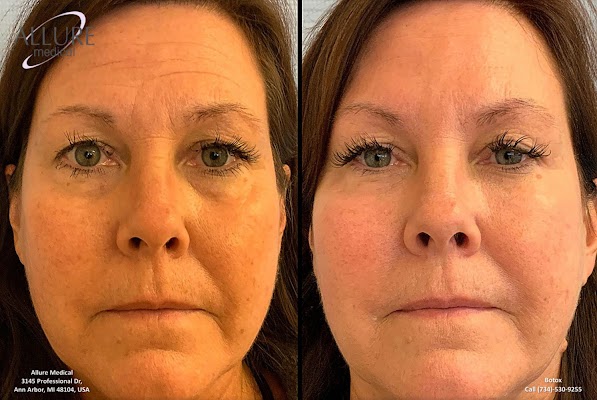
The “right” number for you depends on muscle bulk, pattern of movement, brow position, sex hormones, metabolism, and preference for movement. A fast-twitch gym-goer with thick corrugators may need a few more units than a person with a fine-boned, low-mass glabella. That is why the safest answer to how many units of Botox do I need starts with a face-to-face assessment.
Light Botox vs full correction in the glabella
Patients use different terms, but here is how dosing goals usually break down in the frown area:
Light Botox aims to reduce the harshness of your “elevens” without erasing all movement. Think 10 to 16 units across five points. This works botox near me for first-time users, expressive faces that rely on brow communication, and anyone worried about a frozen look. Expect modest softening at rest and some movement preserved.
Full correction targets near-complete quieting of the corrugators and procerus to smooth etched lines. Expect 20 to 25 units, sometimes 30 for very strong muscles or for those who metabolize quickly. Movement is limited during the peak effect, which helps deep static lines remodel over repeated treatments.
The choice is not only aesthetic. Heavy brows or borderline hooded eyelids do better with conservative dosing to avoid brow heaviness. A balanced plan might pair slightly lighter glabella dosing with small “brow lift” units laterally in the frontalis to support a more open eye.
How the glabella interacts with the rest of your upper face
Treating the glabella in isolation can alter how the forehead and crow’s feet behave. The face is an ecosystem of opposing muscle groups. When you weaken brow depressors in the glabella, the forehead elevator (frontalis) can win a bit, which may create a subtle brow lift. That lift is desirable for many, especially those with low-set brows. But if the frontalis is also heavily dosed for forehead lines, the net effect can be a heavy brow.
For context, the average Botox units for forehead lines typically range from 6 to 16 units spread widely across the frontalis, with attention to your natural hairline and peak of the brow. A conservative frontalis dose paired with a standard glabella dose often looks most natural. The average Botox units for crow’s feet range from 6 to 12 units per side, depending on the length of the lateral orbital lines and your smile dynamics. Because the glabella is a central depressor complex and the crow’s feet sit at the lateral canthus, the trio of glabella, forehead, and crow’s feet is often planned together for facial harmony.
Placement details that affect results
Dosing is more than the number on the syringe. Good results depend on where and how those units land. Corrugator injections should be deep near their origin, then more superficial as the muscle thins laterally to avoid diffusion into the levator palpebrae superioris, which can cause lid heaviness. The procerus injection sits at the bridge, angled into the muscle belly. Spacing matters. Units too close to the orbital rim increase the risk of eyelid ptosis. Units too superior can drift into the frontalis and drop the brows. Precision here does more for natural looking Botox results than adding or subtracting a unit or two.
How to avoid the frozen look
Frozen glabellas usually come from blanket dosing without reading your muscle pattern. If your inner brow movement is asymmetric, equal dosing will freeze the stronger side and under-treat the weaker side, which reads as odd rather than smooth. Your injector should have you frown and relax several times, watching the vectors and noting if the muscle pulls upward or inward more strongly. Small adjustments, such as 1 to 2 units more on the dominant corrugator, avoid a robotic look. Respecting your baseline brow position also matters. If your brows sit low at rest or you have hooded eyes, heavy glabella dosing can make you feel crowded. In those cases, lighter units or staged treatment works better.
Can you get too much Botox in the glabella?
Yes. Overdosing can create a flat brow, impaired expressiveness, and functional issues like brow fatigue. While signs of overdone Botox vary, common clues include peaked or drooped brows that do not match your expressions, a shiny immobile central forehead, and a heavy feeling over the eyes. Over-treatment is not dangerous in healthy patients, but it will take time to wear off. If you notice issues at two weeks, a touch-up may not be the answer. Strategic placement elsewhere can sometimes balance the look, but most cases require patience as the effect fades.
Dosing myths and facts
A persistent myth claims that more units always last longer. In the glabella, once you reach the dose that fully blocks the target motor endplates, extra units make little difference in duration. They do increase the diffusion zone and risk of spread into adjacent muscles. Another myth suggests that repeated Botox leads to permanent muscle atrophy. Over years, treated muscles can soften and slightly thin from disuse. Most patients like that outcome in the glabella because it means you may need fewer units over time. Does Botox thin muscles or weaken muscles long term in a harmful way? In aesthetic dosing, the weakening is temporary and localized. Function returns as neural sprouting restores conduction. We see no evidence that glabella treatment accelerates facial aging. In fact, by reducing repetitive folding, lines at rest improve.
First treatment versus maintenance
For first time Botox advice, I often start 10 to 20 percent below what I predict and schedule a review at day 12 to 14. If lines at rest remain, a small add-on can finish the correction. The Botox touch up timing sweet spot is the two-week mark when the effect has largely matured. Beyond three weeks, additional dosing acts like a new session. Once you stabilize your plan, the Botox maintenance schedule for glabella is typically every 3 to 4 months. Some metabolize faster and prefer closer to 10 to 12 weeks. Others hold softening into month four, especially with smaller muscles and lighter exercise loads.
What you can do before and after to support good results
Bruising and swelling are minor but annoying. Planning helps. In the 5 to 7 days before your appointment, if your medical situation allows, you can minimize bruising by pausing fish oil, high-dose vitamin E, ginkgo, and nonessential NSAIDs. Avoiding alcohol the night before and day of may reduce capillary dilation. If you are on blood thinners under physician guidance, do not stop them for a cosmetic procedure. Communicate your medications during your consult.
Post treatment, gentle care preserves placement. You can wash your face after Botox the same day using light pressure. Avoid aggressive rubbing, gua sha, face massage, and steaming for 24 hours. Can you exercise after Botox? Light walking is fine. Skip vigorous workouts, inversions, and hot yoga for a day to reduce the tiny risk of product migration. Can you sleep after Botox? Yes, though it is wise to avoid sleeping face-down the first night. Minor bumps at injection sites settle within hours. The Botox bruising timeline, if you get one, runs 3 to 7 days for most skin tones, sometimes a bit longer. A cold pack the day of and arnica can help. As for Botox swelling, how long it lasts is usually measured in minutes to hours, not days.
Two common concerns arise in the first week. Can Botox cause headaches? Mild tension-like headaches can occur in the first 24 to 48 hours as muscles adjust. They typically fade without intervention. Can Botox migrate? The molecule does not travel far when injected correctly, but it can diffuse into neighboring muscles if placement is off or if the area is manipulated aggressively right after treatment. Sensible aftercare and an experienced injector keep this rare.
How cost fits into dosing decisions
Botox cost per unit depends on region and practice. In many cities, you will see 11 to 20 dollars per unit. Practices may price per area or per unit. The glabella at 20 units, priced per unit at 14 dollars, would be 280 dollars. If you choose light Botox versus full Botox for the glabella, the cost follows the units used. Ask how your clinic handles touch-ups. Some include a small adjustment at two weeks, others charge per unit regardless. Clear expectations reduce surprises. Custom Botox dosing should be transparent: you should know how many units are planned for each area and why.
Questions worth asking during your consultation
A strong consultation covers more than lines. Ask about the injector’s plan for brow position, their approach to asymmetry, and their touch-up policy. Good Botox dosing explained in plain language is a sign you are in capable hands. Ask where they will place each injection, how they avoid lid ptosis, and how they adapt in expressive faces. If you have an uneven smile, asymmetric eyebrows, or a history of blepharospasm or hemifacial spasm, share it. Prior neuromodulator treatments for medical conditions can change dosing expectations. If you grind your teeth, clench, or do heavy pulling exercises, say so. Muscle activity elsewhere can influence how your upper face compensates.
How the glabella plays with facial shape and harmony
Most people focus on the lines they see, not the shape of their face, yet small dosing choices can tip the eye area open or closed. For round faces that benefit from a bit more lift, balanced glabella dosing with light lateral frontalis units can open the eyes without arching the brow into a surprised look. For heart shaped faces with higher lateral brows, over-relaxing the glabella can exaggerate a central dip. Subtle lateral brow support creates a smoother line. For square or wide jaw appearance, glabella dosing stays standard, but you may notice that masseter treatments for facial slimming can change how your upper face reads. When the jaw narrows, the eyes draw more attention, so crisp glabella work becomes even more important. Botox customization by face shape is not about big changes. It is about 1 to 2 unit tweaks and thoughtful placement.
What results to expect and when
The onset of glabella softening starts around day 2 to 4, with peak at day 10 to 14. Early movers often notice a lighter furrow by day 3. If your lines are etched at rest, do not judge the success on movement alone. With repeated treatments, the skin has a chance to remodel. Deep creases that have lived there for years often need a full correction dose plus time. Skin quality measures help: sunscreen, retinoids as tolerated, and regular moisturizing improve the canvas so your results look smoother.
Botox for skin texture and Botox for pore size get discussed often. Classic neuromodulator in the muscle does not directly shrink pores, but by calming expression and reducing sebum flow slightly, many notice skin looks a bit smoother. If pore size is your priority, microinjections in the dermis using diluted neuromodulator is a different technique, not the same as glabella dosing. Keep those conversations distinct.
Safety boundaries and edge cases
A few scenarios require extra care. If you have a low brow or hooded eyes, heavy glabella dosing risks weighing down the brow. In such cases, conservative dosing and careful spacing are key, with the option to add units later. If you are very expressive in your job or performance work, light glabella dosing preserves the micro-movements you use. If you suffer tension headaches, small glabella and frontalis doses sometimes reduce symptom frequency, but the protocol for chronic migraine involves many more sites and higher total units across the scalp and neck. That is a medical treatment distinct from aesthetic dosing.
If you ask, can Botox affect blinking, speech, or chewing, the answer for glabella treatment is that it should not when placed correctly. Those functions relate to different muscles. Problems in those areas suggest diffusion or dosing in unintended muscles, which points back to technique rather than the medicine itself. Can Botox affect smile or eyebrow symmetry? Yes, if placement is asymmetric. That is why the two-week check is valuable.
How the glabella fits in a longer plan
Many patients want to understand long term effects of Botox on the face. The glabella tolerates repeated treatment well. Over years, you may notice you need a few fewer units for the same result because the muscle no longer fights as hard. This is not harmful muscle loss in the way we worry about limb strength. It is targeted and modest. The benefit shows up as fewer etched lines and softer resting tension in the inner brow. For maintenance, some rotate treatment intervals seasonally. During stressful periods, you may furrow more and choose a slightly higher dose. During quieter seasons, you might stretch to four months.
If you pursue other treatments, sequence matters. Botox and microneedling can be done in the same month, often with neuromodulator first, then microneedling a week later to avoid mechanical spread. Botox and chemical peels can be combined with similar spacing. Lasers that cause swelling near the eye should not immediately follow injection day. With skincare, retinol use is fine to continue unless your skin is irritated at injection time. Botox and alcohol consumption the day of treatment is not wise due to bruising risk. Caffeine intake is safe, but large amounts can increase jitteriness and vasodilation, which does not help bruising.
A brief word on related areas people ask about
The glabella can influence how lifted the brows look, which leads to common questions: can Botox lift eyebrows or lift eyelids. Relaxing the glabellar depressors allows the frontalis to win, giving a mild lift in many faces. It will not fix heavy eyelid skin. For hooded eyes, a thoughtful brow strategy helps, but do not expect a surgical result from a few units. Downturned mouth corners and marionette lines are unrelated to the glabella dose. Those involve depressor anguli oris and mentalis muscles, treated with small strategic units. A nose tip lift uses 2 to 4 units in the depressor septi nasi, not the glabella. Lip asymmetry or chin projection adjustments are their own plans. Neck tightening and platysmal bands involve the platysma, a separate protocol entirely. The point is, each area has its own dosing logic. Trying to solve several with one session is fine, but they should be mapped individually.
Two quick checklists to make your appointment smoother
Pre-appointment checklist:
- List your medications and supplements, including blood thinners and herbals. Avoid alcohol for 24 hours and optional blood-thinning supplements for 5 to 7 days if safe. Take clear photos of your frown at rest and in motion for comparison. Arrive with clean skin, no makeup on the upper face. Prepare two or three specific goals, such as “soften the 11s but keep a little movement.”
Aftercare checklist, first 24 hours:
- Keep your head upright for several hours and avoid face-down massage or goggles. Skip intense exercise, hot yoga, and saunas. Do not rub or press hard on the injected areas. Use gentle cleansing and minimal skincare products that night. Book or confirm your two-week follow-up to assess results.
When less or more makes sense
There are times when deviating from the 20-unit standard is prudent. If your brows are naturally high and you want a polished, camera-ready look with minimal motion, a slightly higher dose at the first session can get you there. If your brows are low-set and your eyes feel heavy with hats or glasses, light dosing prevents a weighed-down sensation. If you have an asymmetrical eyebrow shape, split dosing helps equalize the appearance. If your furrow is faint but you squint into sun often, adding small crow’s feet units and being diligent with sunglasses may help as much as adding glabella units. If you grind your teeth, correcting masseter hypertrophy can sometimes reduce upper-face overcompensation, changing how much the glabella needs.
How to judge a good result
A strong outcome in the glabella looks like you on a rested day. At rest, the vertical lines fade or vanish. In motion, you can still convey concern or focus with a gentler crease if you chose a light plan, or you see minimal central fold if you chose full correction. Brows sit in a neutral, balanced position, not overly peaked or flattened. No lid heaviness, no brow asymmetry. Touching your forehead, you may notice less tension in the inner brow. Friends might comment that you look well slept, not that you had something done.
If anything feels off, bring it up at your follow-up. A tiny lateral brow flick can often be balanced with 1 to 2 units. A residual furrow line may benefit from a small top-up. The window for tweaks is short, which is why that two-week check matters.
Putting it all together: your personalized number
So, how many units should you get for frown lines? For most adults, 15 to 25 units of Botox Cosmetic spread over five points is the reliable starting framework. Light Botox sits around 10 to 16 units for subtle softening. Full correction lands at 20 to 25 units for smoother skin and minimal frown motion. Adjust up or down based on muscle strength, brow position, and how much movement you want to keep. Pairing with conservative forehead dosing avoids heaviness. Respect the timelines: onset by day 3, peak at two weeks, maintenance at 3 to 4 months.
Keep the plan simple, the technique precise, and your goals clear. Glabella dosing is less about chasing a number and more about reading your anatomy and tailoring the units to fit your face. That is how you move past myths, avoid a frozen look, and land the natural result most people want.